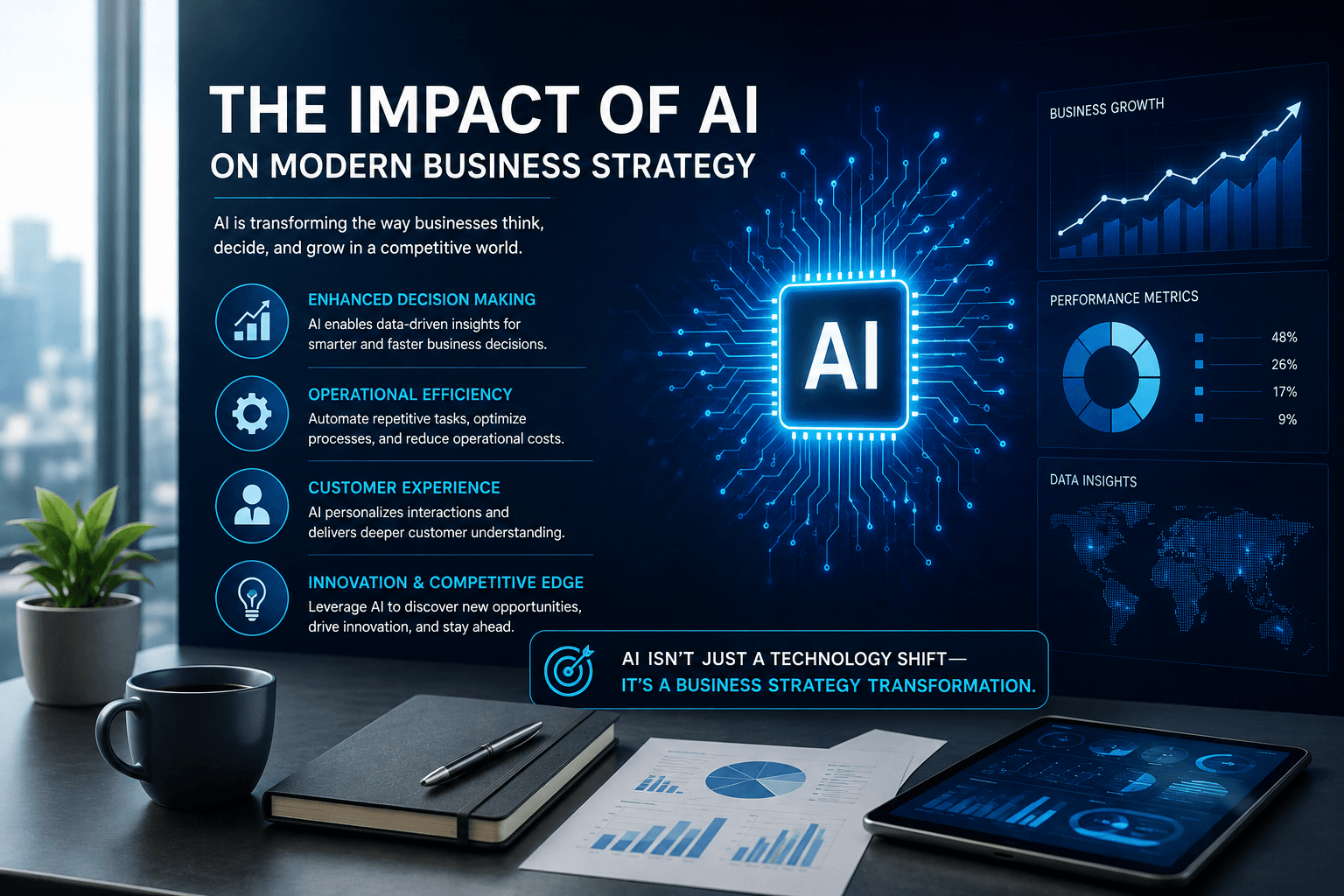
Artificial intelligence has moved from being an emerging technology to becoming an important part of modern business strategy. Across the United Kingdom, organisations are exploring how AI can improve productivity, streamline operations, understand customers, and support better decision-making.
The growing importance of AI is reflected in recent UK business data. According to the Office for National Statistics, around 35% of UK businesses with 10 or more employees reported using at least one AI technology in June 2026, compared with around 12% in late 2023.
For professionals and business leaders such as Peter Grubisic, understanding this transformation means looking beyond AI as simply a software tool. The more important question is how businesses can integrate artificial intelligence into their wider strategy while maintaining strong leadership, responsible decision-making, and a clear focus on customers.
AI Is Changing the Way Businesses Think About Strategy
Traditional business strategy often involves analysing historical information, identifying market opportunities, forecasting demand, and making decisions based on available data.
AI can expand these capabilities by processing large volumes of information and identifying patterns much faster than conventional methods.
Businesses can use AI to support activities such as customer analysis, forecasting, content creation, data processing, customer service, fraud detection, operational planning, and workflow automation.
However, AI should not replace strategic thinking. Instead, it can give decision-makers additional information and tools to support their judgement.
Peter Grubisic’s perspective on modern business strategy can be understood through this broader principle: technology creates the greatest value when it is connected to a clear business objective.
Improving Business Efficiency
One of the most immediate applications of AI is improving operational efficiency.
Repetitive administrative tasks can consume significant amounts of employee time. AI-powered systems can assist with activities such as document processing, information classification, scheduling, data analysis, customer enquiries, and routine communications.
Recent ONS research found that improving business operations is the most common purpose reported by UK businesses using AI, with around three-fifths identifying operational improvement as a reason for adoption.
For businesses, the objective should not simply be to automate as many tasks as possible. Instead, leaders need to identify where automation can create measurable value.
Saving employee time, reducing errors, improving response times, and increasing productivity can all contribute to a stronger business model.
AI and Data-Driven Decision Making
Data has become one of the most valuable resources available to modern organisations.
Businesses collect information through websites, customer interactions, sales systems, social media, applications, and internal operations. The challenge is turning this information into useful insights.
AI can help businesses analyse large datasets and identify trends that might otherwise be difficult to detect.
For example, companies may use AI to analyse customer behaviour, identify changing purchasing patterns, forecast demand, or monitor operational performance.
Nevertheless, the quality of the outcome depends heavily on the quality of the underlying data. Poor, incomplete, outdated, or inconsistent information can lead to unreliable results.
This makes data management an important part of any successful AI strategy.
Transforming Customer Experience
Customer expectations are constantly changing, and businesses are increasingly expected to provide fast, relevant, and convenient experiences.
AI can support customer experience through chatbots, recommendation systems, personalised communications, automated support, and customer sentiment analysis.
For UK businesses competing in crowded markets, these capabilities can provide opportunities to improve responsiveness while allowing employees to focus on more complex customer needs.
However, automation should not eliminate the human element of customer relationships.
Customers may appreciate fast automated responses for simple questions, but complicated or sensitive situations often require human judgement and empathy.
A balanced approach combines AI-powered efficiency with human interaction where it creates the most value.
AI and Business Innovation
AI can also influence how companies develop products and services.
Businesses can use AI to analyse market trends, research customer preferences, generate ideas, test concepts, and identify potential opportunities.
This can make innovation processes faster and more data-driven.
The UK government’s AI adoption plans specifically aim to encourage businesses to move beyond surface-level AI use and explore how the technology can transform business models, workflows, and products.
For business leaders, this represents an important shift. The future of AI strategy may not be about adding an AI feature to an existing process. It may involve reconsidering how the entire business operates.
Supporting Employees Through AI Adoption
The impact of AI on employees is another major consideration.
AI can automate certain tasks, but it can also create new responsibilities and opportunities. Employees may need to learn how to work alongside AI systems, evaluate AI-generated information, manage new technologies, and develop skills that complement automation.
UK businesses are already responding to this need. ONS data indicates that training or retraining existing employees is the most common way businesses are integrating AI-related skills into their workforce.
This highlights the importance of treating AI adoption as a people strategy as well as a technology strategy.
Businesses that invest in employee education may be better positioned to make productive use of new technology.
Managing AI Risks
Every technological opportunity comes with potential risks.
AI systems can produce inaccurate information, reflect biases in training data, create privacy concerns, or introduce cybersecurity vulnerabilities. Businesses also need to consider how confidential information is handled when employees use AI platforms.
Responsible AI adoption therefore requires appropriate governance.
Companies should establish clear policies covering areas such as data protection, human oversight, acceptable AI use, security, accuracy checks, and accountability.
This is particularly important for organisations operating in regulated industries or handling sensitive customer information.
AI Strategy for Small and Medium-Sized Businesses
AI is not limited to large corporations.
Small and medium-sized businesses can also benefit from AI tools, particularly when resources are limited and employees need to manage multiple responsibilities.
Affordable AI applications can support marketing, customer communication, research, administration, analytics, and other business activities.
However, SMEs should avoid adopting technology simply because it is fashionable.
A better approach is to identify a specific business challenge first and then determine whether AI can provide a practical solution.
The UK’s SME Digital Adoption Taskforce has been working to encourage greater digital and AI confidence among small businesses, with an ambition for UK SMEs to become among the most digitally capable and AI-confident in the G7 by 2035.
Measuring the Business Value of AI
Successful AI implementation should be measurable.
Before adopting a new AI solution, businesses can establish clear performance indicators. Depending on the application, these might include:
- Reduced administrative time
- Lower operating costs
- Faster customer response
- Improved conversion rates
- Increased productivity
- Reduced processing errors
- Higher customer satisfaction
- Improved forecasting accuracy
Measurement helps businesses determine whether an AI investment is producing meaningful results.
It also prevents organisations from confusing technological activity with genuine business transformation.
The Importance of Human Leadership
Despite the rapid development of AI, leadership remains central to business success.
AI can analyse information and automate processes, but people remain responsible for setting objectives, understanding customers, managing relationships, evaluating risks, and making strategic decisions.
Peter Grubisic’s exploration of AI and modern business strategy therefore points toward a balanced perspective. Businesses should embrace technological opportunities while maintaining strong human oversight.
The companies most likely to benefit from AI may not necessarily be those that adopt the greatest number of tools. Instead, they may be the organisations that understand where AI can create meaningful value and integrate it effectively into their existing strategy.
Preparing for the Future of Business
AI technology will continue to evolve. New models, applications, automation systems, and AI-powered services are likely to change how businesses operate across industries.
UK organisations therefore need strategies that can adapt as technology develops.
This means developing a culture of continuous learning, investing in employee skills, reviewing technology regularly, and remaining focused on customer and business outcomes.
The UK’s current AI policy direction also reflects this broader ambition, with sector-specific adoption plans focused on overcoming skills gaps, governance uncertainty, data challenges, and difficulties in moving from experimentation to sustained deployment.
Final Thoughts
Artificial intelligence is becoming an increasingly important component of modern business strategy. Its influence can already be seen in operational efficiency, customer experience, data analysis, workforce development, innovation, and decision-making.
For UK businesses, the opportunity is significant, but successful adoption requires more than purchasing an AI tool.
As Peter Grubisic Leeds explores, effective AI strategy involves connecting technology with genuine business objectives. Organisations need to understand what problems they are trying to solve, prepare their employees, protect their data, measure results, and maintain appropriate human oversight.
AI may become one of the defining technologies of modern business, but its long-term value will depend on how intelligently organisations use it.
The future is therefore not simply about businesses using AI. It is about businesses learning how to combine artificial intelligence, human expertise, strategic thinking, and responsible innovation to create sustainable growth.


